


The Tokyo Metropolitan Government conducted the “Survey of Men’s Housework and Childrearing 2025” of 5,000 respondents, and compared to the previous survey conducted in 2023 ( click here), what changes have been made?
We will discuss the results of this survey, unraveling the gender gap in time spent on housework and childcare and changes in satisfaction with the division of housework and childcare, based on advice from experts. In addition, we will introduce the survey results in two parts, touching on the communication gap between married couples and new issues and concerns that have emerged with the increasing number of men engaged in child-rearing*!
*”Ikugyo” is a nickname for “childcare leave” decided by the Tokyo Metropolitan Government through public solicitation. The Tokyo Metropolitan Government is working to change the mindset that childcare is not a “vacation” but an “important task to nurture the future,” and to foster a spirit of support for “childcare work” throughout society.

Mr. Shingo Ikeda
Deputy Chief Researcher, Japan Institute for Labour Policy and Training (JILPT)
Director, Japan Institute for Labour Relations
Father of four
“Life & Career in Sociology” (Chuokeizai-sha/Co-editor)

Tae Amano
Representative Director, Respect each other, Inc.
National Qualified Career Consultant (Ichizai)
Certified Coach, Lifelong Learning and Development Foundation
Mother of three daughters
“‘Men on maternity leave’: How families, businesses and economy change” (PHP Shinsho/ co-author)

Illustrator
Eiichi
Father of 1 child
Serialization of child-rearing manga on Tokyo Metropolitan Web site “TEAM Housework & Childcare”
Author of “Skinhead Dad’s Childcare Diary” (Nikkei BP)
The gap between men and women in time for housework and childcare has narrowed! What fathers and mothers want most is “free time
(1) Time spent on housework and childcare declines for both men and women, possibly due to women’s entry into the workforce, increased efficiency, and reduced psychological burden.
Q. What is the average amount of time per day you spend on housework, childcare, and caregiving?
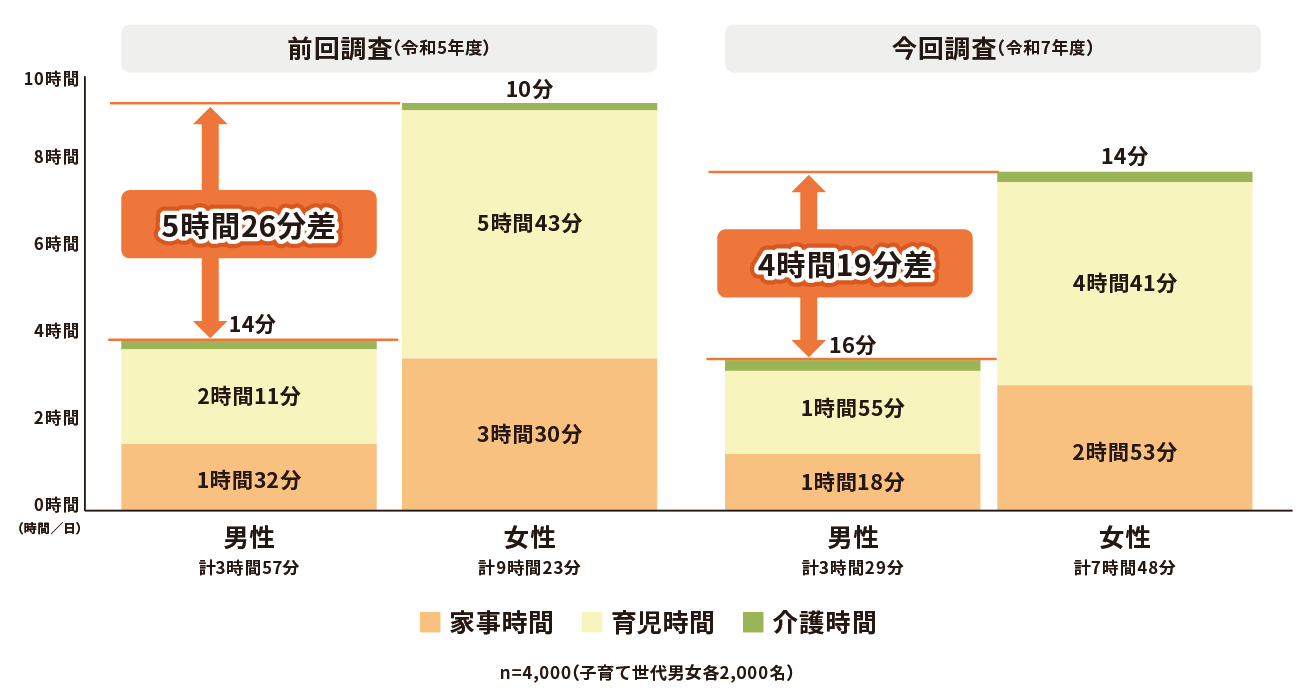
Looking at the average daily time spent on housework, childcare, etc., men spent 3 hours and 29 minutes and women 7 hours and 48 minutes, a difference of 4 hours and 19 minutes. This is a decrease of more than one hour from the previous survey, when the difference was 5 hours and 26 minutes. It is noteworthy that women’s time for housework and childcare, in particular, has decreased significantly from the previous survey. This is thought to be due to the fact that women have advanced in society, with an increase in the number of women working full-time or in managerial positions, as well as a decrease in the amount of time spent on housework and childcare in the household as a whole due to the use of outside services and other factors.
In addition, the figures may indicate a reduction in the burden on women in terms of their feelings toward housework and childcare, as men have increased their childcare duties and there are more occasions for couples to engage in housework and childcare together.
Mr. Amano Point
The total amount of housework and childcare to be shared between husband and wife is decreasing. As in the case of work, people are becoming more conscious of “time performance” and “cost performance,” and this is reflected in the increasing number of people who can handle household chores without strain while making good use of home appliances and housekeeping services.
The significant decrease in the number of women who answered that they spend “8 hours or more” a day on housework suggests that there are fewer cases of “one-parent” households, where a single person is responsible for housework and childcare for a long period of time. As a result, it is possible that the amount of time spent on housework is being sensibly estimated to be shorter.
For example, time seems longer when working alone, but it seems shorter when working together with others. Household chores are the same way; if we cooperate with each other, the fun may be doubled and the hard work halved.
Mr. Ikeda Point
Rather than men suddenly taking on more housework and childcare, a more significant change is the decrease in the amount of time spent on housework and childcare by the family as a whole, as more women work as full-time employees or in managerial positions.
There may be some aspects of housework that are becoming more externalized. For example, they successfully incorporate eating out and side dishes from supermarkets. In some respects, it is precisely because Tokyo has such a wide range of services that support people’s lifestyles that the time spent by families as a whole on housework and childcare is decreasing.
(2) Satisfaction of “moms” with the division of household chores and childcare increased significantly!
Q. Are you satisfied with the division of housework and childcare between husband and wife?
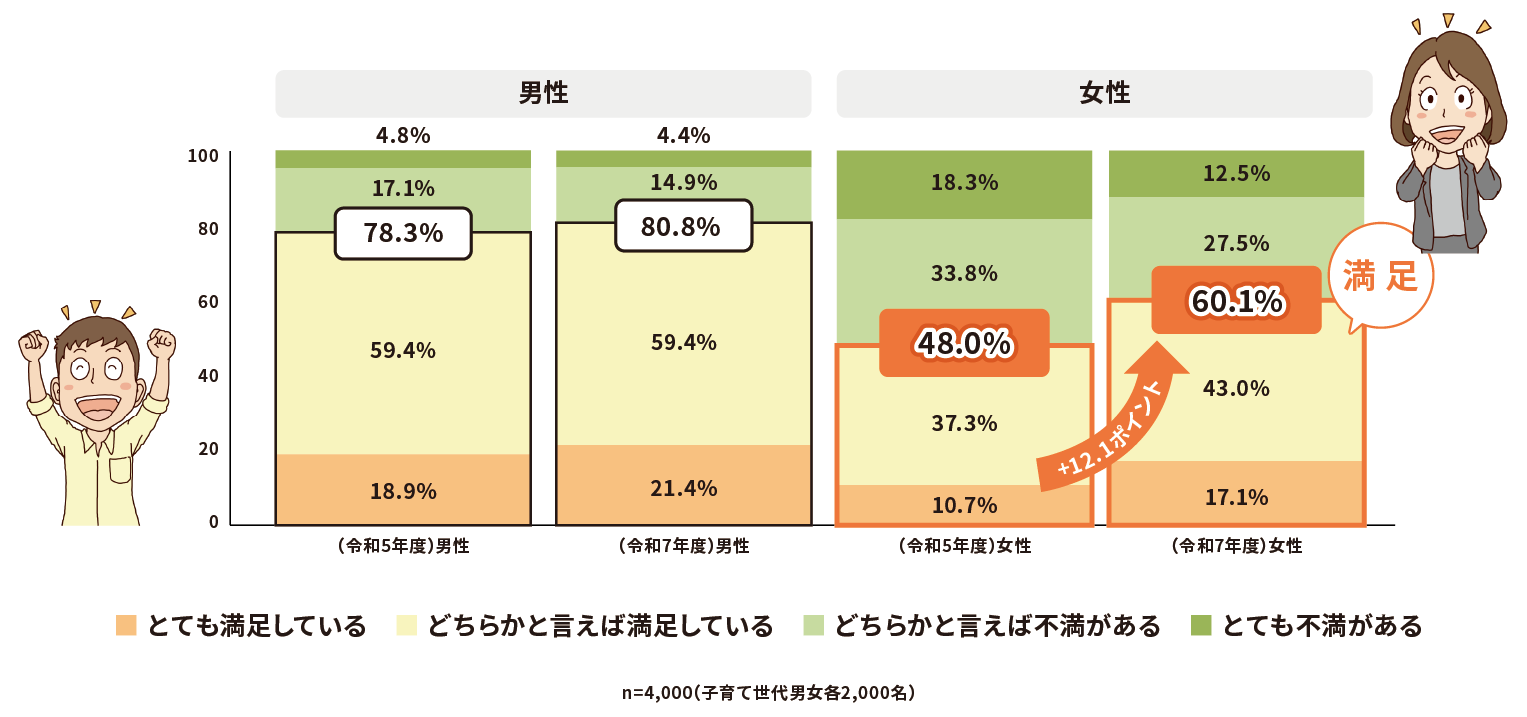
The satisfaction level of men tends to be high as in the previous survey, but there is still a large gap with women. However, the level of satisfaction among women has improved significantly from the previous survey, with the percentage of respondents who answered “very satisfied + somewhat satisfied” increasing 12.1 points from 48.0% in the previous survey to 60.1%.
As women’s time for housework and childcare is decreasing and the time gap with their spouses is shrinking, it is thought that more women are finding that their emotional burden has been reduced.
There was also a tendency for satisfaction to be higher among women whose spouses were engaged in childcare.
Mr. Ikeda Point
Looking at the results of the “satisfaction” rating, which increased even though the amount of time spent with children decreased, it can be assumed that an increasing number of people are valuing their relationship with their children while saving labor for the things they do as part of their child-rearing duties. Perhaps there is a growing tendency to reduce the burden of child-rearing and to enjoy life with children.

(3) The gift that both dads and moms want most is “time to themselves!
Q. If you could receive a gift for your hard work in housework and childcare, what would it be?
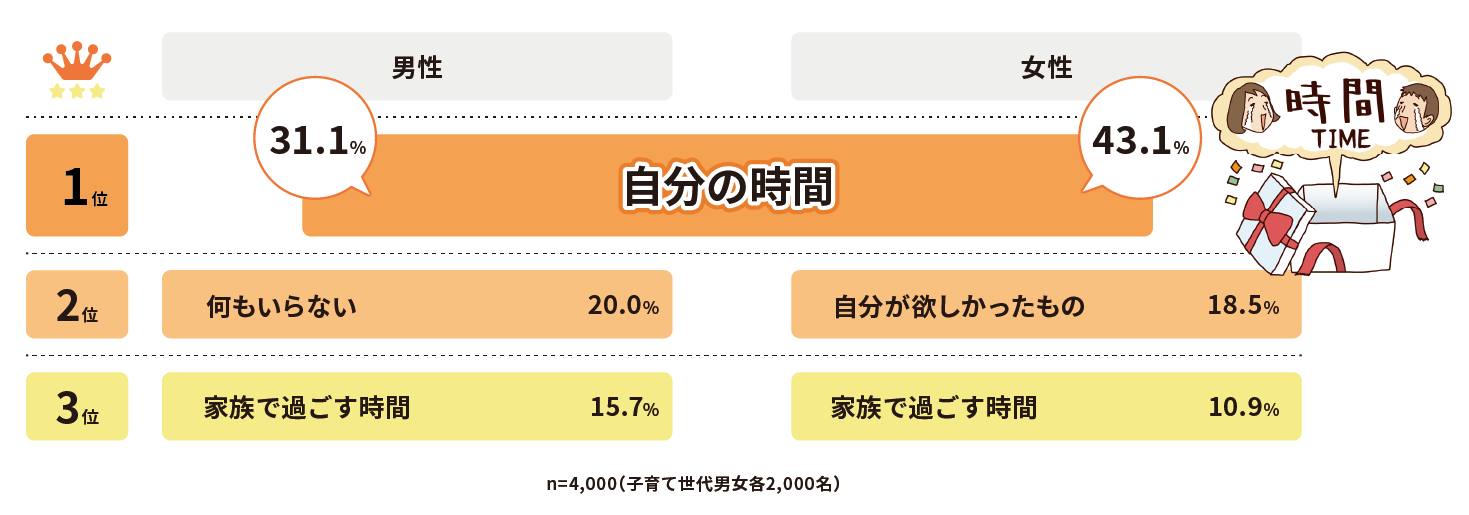
For both men and women, “Time for myself” ranked first. In particular, 43.1% of women chose “time for myself,” far surpassing the second-place answer of “things I wanted” (18.5%).
How much free time do moms and dads actually have?
(4) Both men and women have about 2 hours of free time on weekdays. (5) The difference between men and women is noticeable on Saturdays and Sundays
Q. What is your average free time per day?
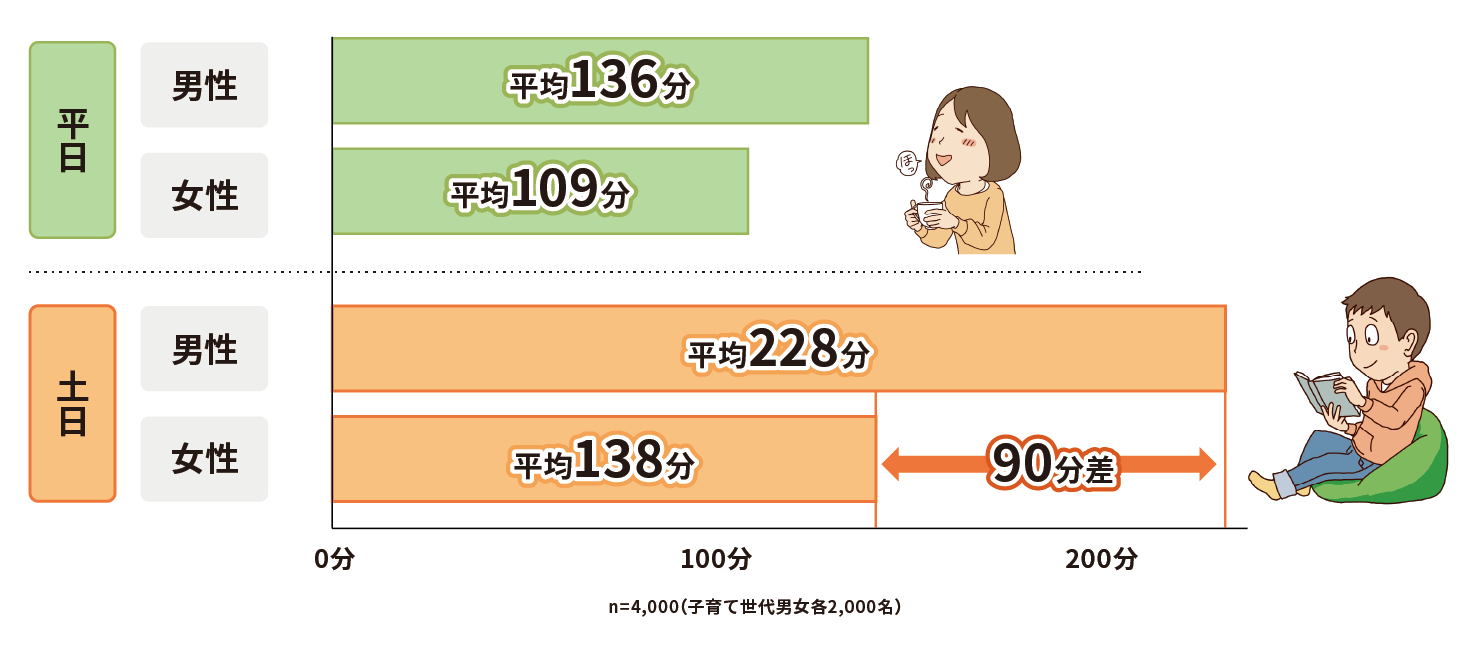
On weekdays, both men and women have around 2 hours of free time, with no significant difference between men and women. On weekends, however, the difference between men and women is 90 minutes, indicating that men tend to have more free time than women.
For moms and dads who struggle with housework and childcare on a daily basis, securing free time can improve their quality of life and satisfaction. Sometimes, it is a good idea to give each other the gift of free time, the “thing you want most!
2. The big gap between men and women in “frequency of being thanked”
That “thank you” is not getting through!
(1) “Discussion” and “appreciation” are keys to improving satisfaction with housework and childcare sharing.
When asked what they thought was important to increase satisfaction with the division of household chores and childcare, the most common response from both men and women was “frequent discussion and cooperation between spouses,” followed by “mutual appreciation.
As “satisfaction with the division of household chores and childcare” continues to grow, it appears that deepening communication between married couples will be the key to further improving satisfaction.
(2) Even if men “think they are grateful”, women do not fully understand!
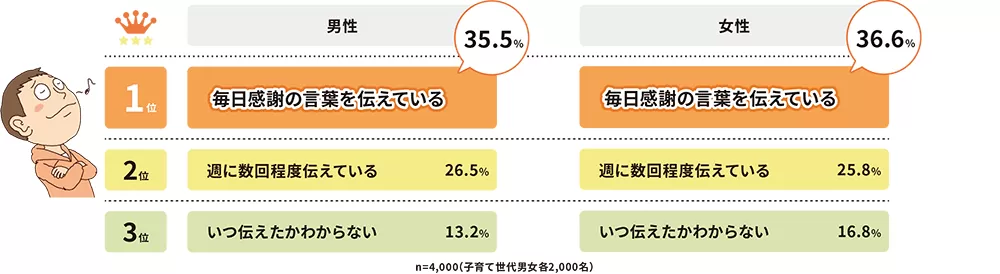
Q. How often do you express your appreciation when your spouse does housework and childcare?
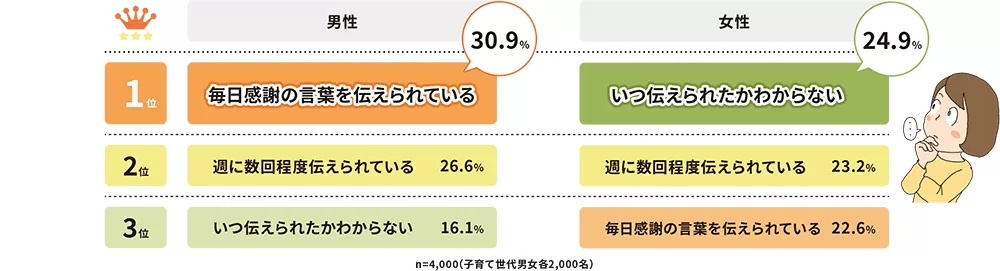
Q. How often do you receive words of appreciation from your spouse for your housework and childcare?
In the frequency of expressing gratitude to their spouses, both men and women ranked “Everyday” first and “Several times a week” second, suggesting that they express their gratitude to each other.
On the other hand, when asked about the frequency with which they are thanked by their spouses, men ranked “Everyday” first, while women ranked “I don’t know when” first. It is possible that even when men think they are expressing their appreciation, it is not conveyed very well to women.
(3) Why don’t you express your gratitude? Men are “embarrassed” and women are “natural
Q. Please tell us why you don’t say thank you very often.
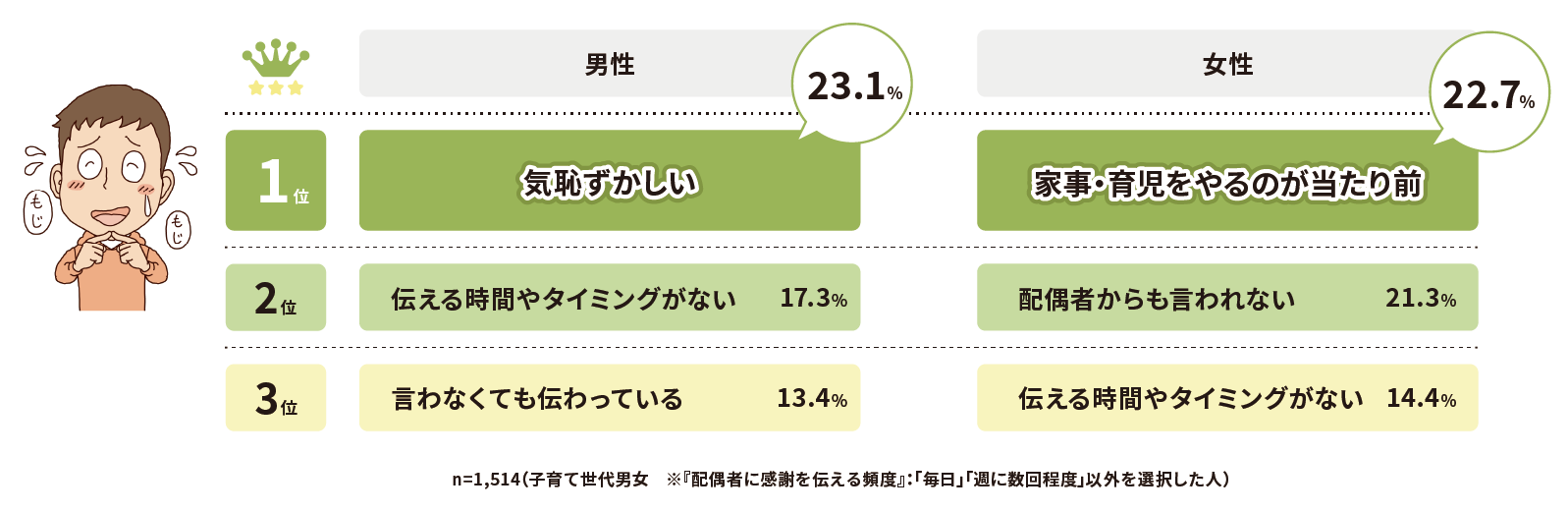
A significant difference was also found between men and women in terms of reasons for not expressing gratitude. While men feel “embarrassed” to express their gratitude, many women see it as “natural” to do housework and childcare, indicating that there are differences in attitudes and awareness toward expressing gratitude.
Many women also answered, “My spouse doesn’t say it either,” indicating that they feel they are not being thanked. There seems to be a discrepancy with the third-ranked male response, “Even if it is not said, it is understood.
Mr. Amano Point
When problems arise between spouses, the cause is often not so much the content itself, but rather the “way” of speaking. This is when assertive communication is important, in which you communicate your feelings and desires while respecting the other person.
The first step in building a good relationship is to say “thank you for ________” on a regular basis, a “word of approval” that acknowledges the other person’s actions and presence.
In addition, simply putting “I” in the subject, such as “I felt this way,” will greatly change the way you communicate with the other person. This is the basis of communication not only between husband and wife, but also with colleagues and subordinates in the workplace.
Furthermore, when men express their gratitude, it may be just right to do so with a little exaggeration, with a tone of “Thanks a lot, Mom!” is probably just the right tension to express their gratitude. On the other hand, when a woman feels that she would like to be thanked more, it is also important for her to express her honest feelings by saying, “I would be happy if you were a little more pleased.
Mr. Ikeda Point
There is no clear line in housework and childcare that says, “If you have done this much, you are done. That is why it is important for couples to have a thorough discussion. Since ” I want you to do it, but you won’t do it” can cause a lot of stress, it is important to share with each other in words how much you are willing to commit and what you expect from the other person.
Also, why not take the plunge and make a day when you are a one-person operation and leave all housework and childcare to your husband? By doing so, they may be able to tackle the housework and childcare that their husbands do not normally do.
And it is important for both husbands and wives to honestly say “thank you” on the spot for what they have done. I believe that the sight of parents expressing their gratitude in words will have a positive impact on the discipline of their children.
4) Real voices of moms and dads! This is how to solve communication problems between husband and wife
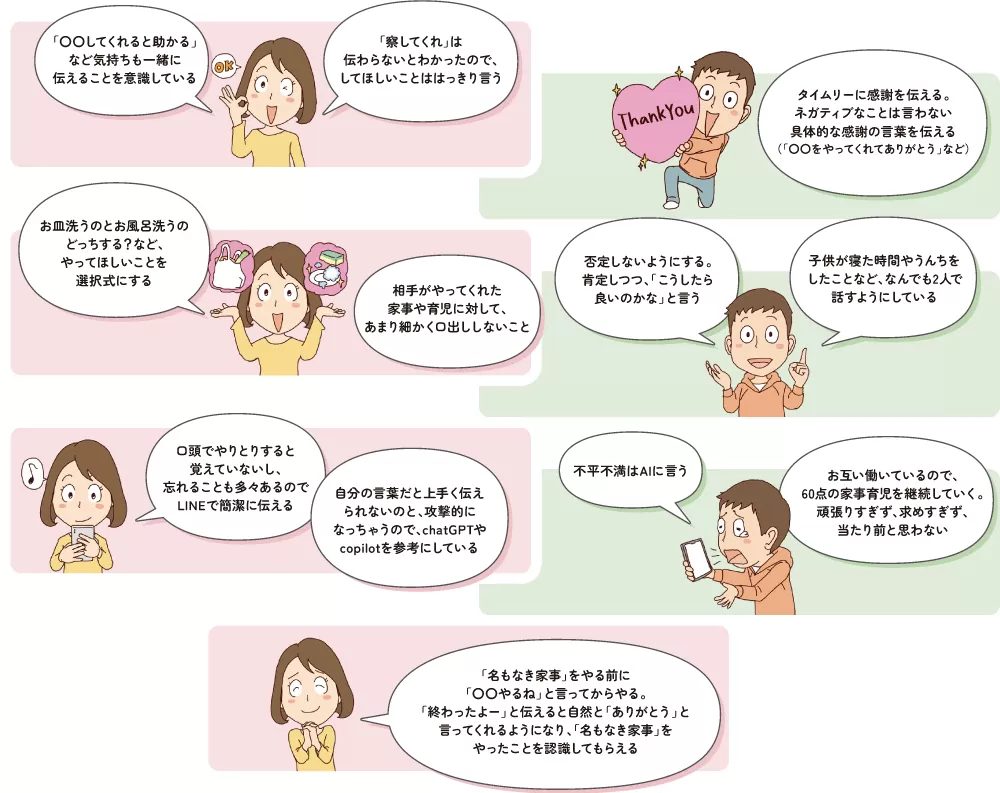
What women should share the most is the “unnamed housework”!
Household chores with no name” refer to the small, daily chores that have no name but that someone else is responsible for, such as “refilling shampoo” or “checking the level of leftover seasoning. Since they do not have names, they are not easily recognized as burdens and tend to cause inequity and stress in the division of household chores.
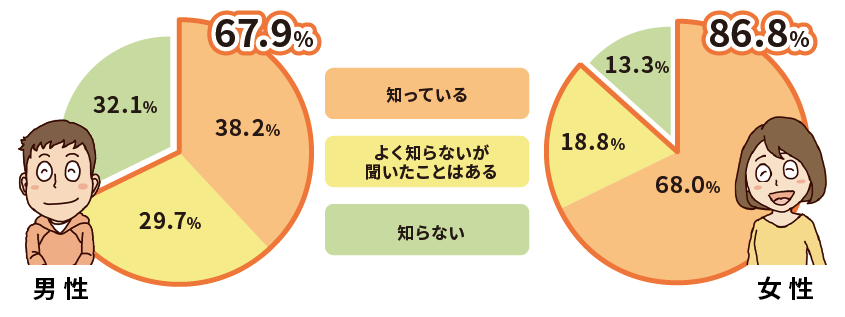
There is a 20% difference in awareness of “nameless household chores” between men and women, with women ranking “nameless household chores” as the number one household chore they would like their spouses to share more of. In addition, men who know about “nameless chores” spend more time on housework and childcare than women, suggesting that increasing men’s awareness of “nameless chores” may help bridge the gap between spouses.
Mr. Amano Point
First of all, it is important to “visualize ” your chores, that is, to express them in words. By verbalizing your chores, your actions will take on meaning and value, and your mindset will change. For example, using a “secret word” that only family members understand may make housework a little more enjoyable and make it seem less burdensome. For example, we recommend naming the chore of replacing the net that catches debris in the drain “catcher shift” or other unique names. A little bit of playfulness may become the essence of a positive approach to daily housework.
Q. Are you familiar with the term “nameless chore”?
Check out
for useful information on “Housework Without a Name.”

(5) The common features of happy couples were “conversation” and “gratitude!
Q. Conversation time with spouse (Sat/Sun) x marital happiness
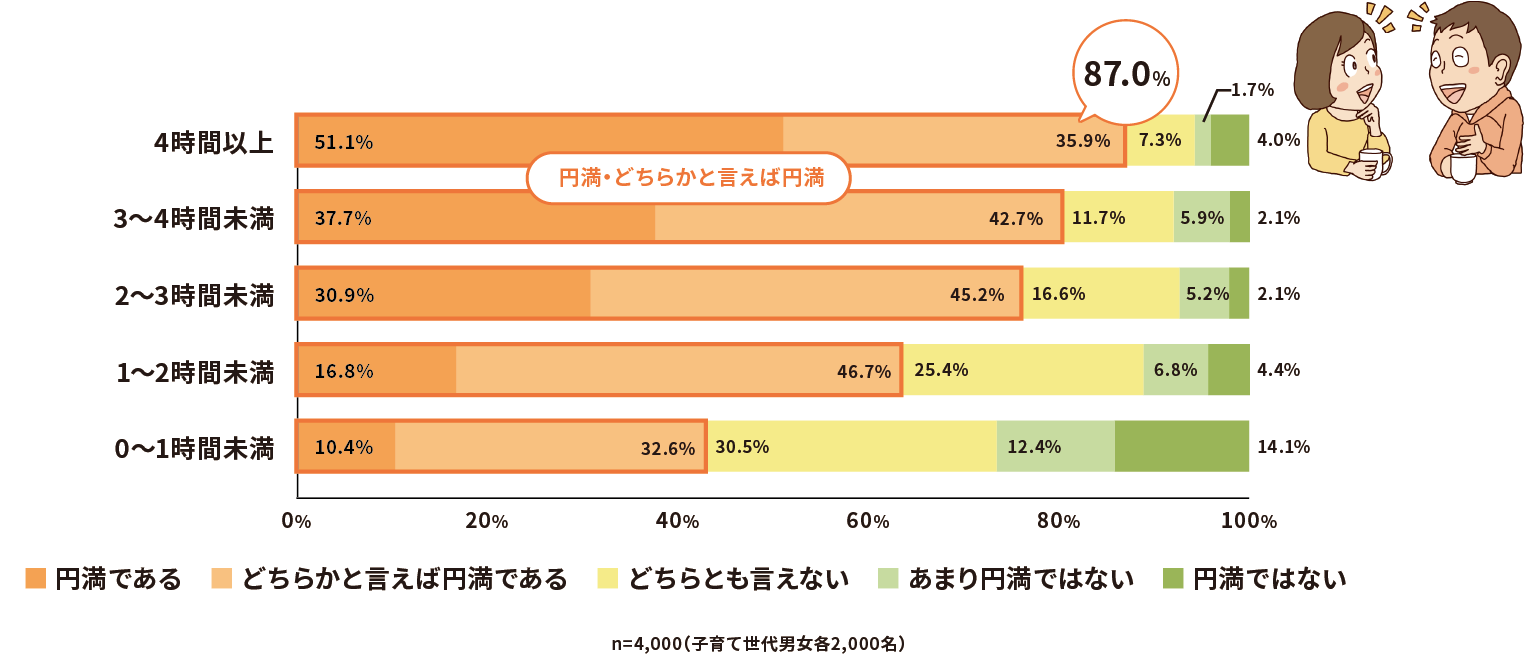
The longer a couple talked, the more likely they were to report that their marriage was happy.
In addition, a cross tabulation of the results of “How often your spouse expresses gratitude to you” and “Do you think your marriage is happy?” showed that the more frequently your spouse expresses gratitude to you, the more likely you are to be happy in your marriage.
It was also found that the more frequently both men and women expressed gratitude, the higher their satisfaction with the division of housework and childcare. It appears that marital communication and words of appreciation are important points for both marital happiness and satisfaction with the division of housework and childcare.
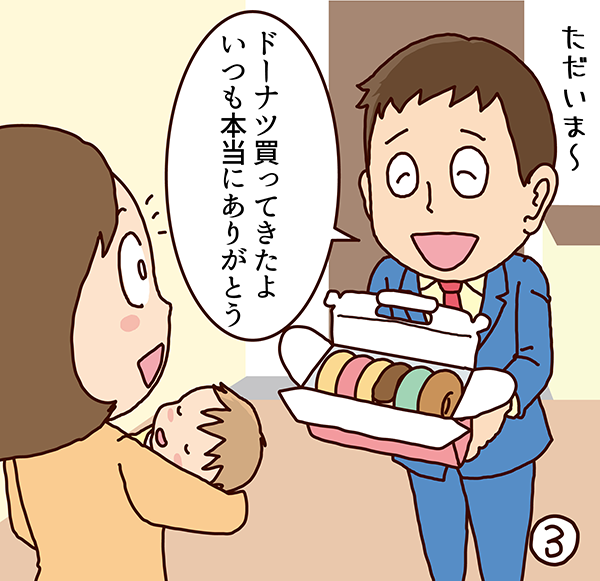
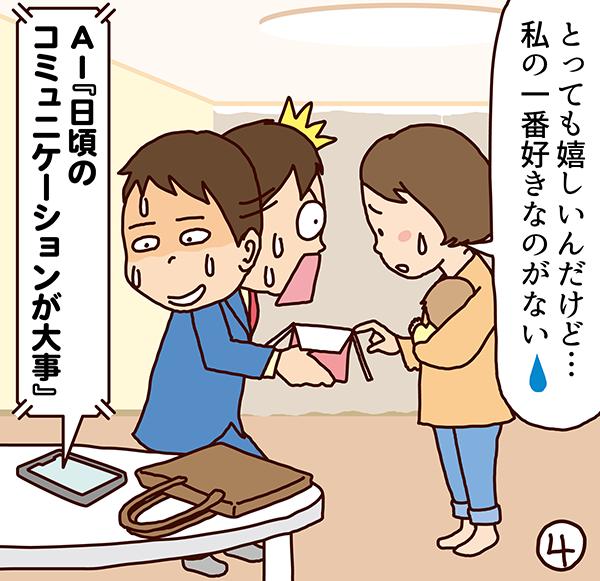

In this second issue, we present the results of our survey on the state of male childcare and the concerns of the child-rearing generation. Please take a look!
All survey results are available here.
Survey on Men’s Housework and Childcare 2025
Survey period: July 15-August 21, 2025
Survey target: 5,000 Tokyo residents (2,500 men and 2,500 women each)
Target1 Child-rearing generation … 4,000 men and women with preschool children (2,000 men and 2,000 women each)
Target2 All generations. .. 1,000 men and women aged 18-69 ( 500 men and women each)