


The Tokyo Metropolitan Government conducted the “Survey of Men’s Housework and Childrearing 2025” of 5,000 respondents, and compared to the previous survey conducted in 2023 ( click here), what changes have been made?
We will discuss the results of this survey, unraveling the gender gap in time spent on housework and childcare and changes in satisfaction with the division of housework and childcare, based on advice from experts. In addition, we will introduce the survey results in two parts, touching on the communication gap between married couples and new issues and concerns that have emerged with the increasing number of men engaged in child-rearing*!
*”Ikugyo” is a nickname for “childcare leave” decided by the Tokyo Metropolitan Government through public solicitation. The Tokyo Metropolitan Government is working to change the mindset that childcare is not a “vacation” but an “important task to nurture the future,” and to foster a spirit of support for “childcare work” throughout society.
3. male childcare situation: mindset change for both fathers and society!
(1) The rate of men taking childcare leave is increasing One out of every three fathers of 0-year-olds has taken childcare leave for at least one month!
Q. For your youngest child, what is your own “child-rearing period”?
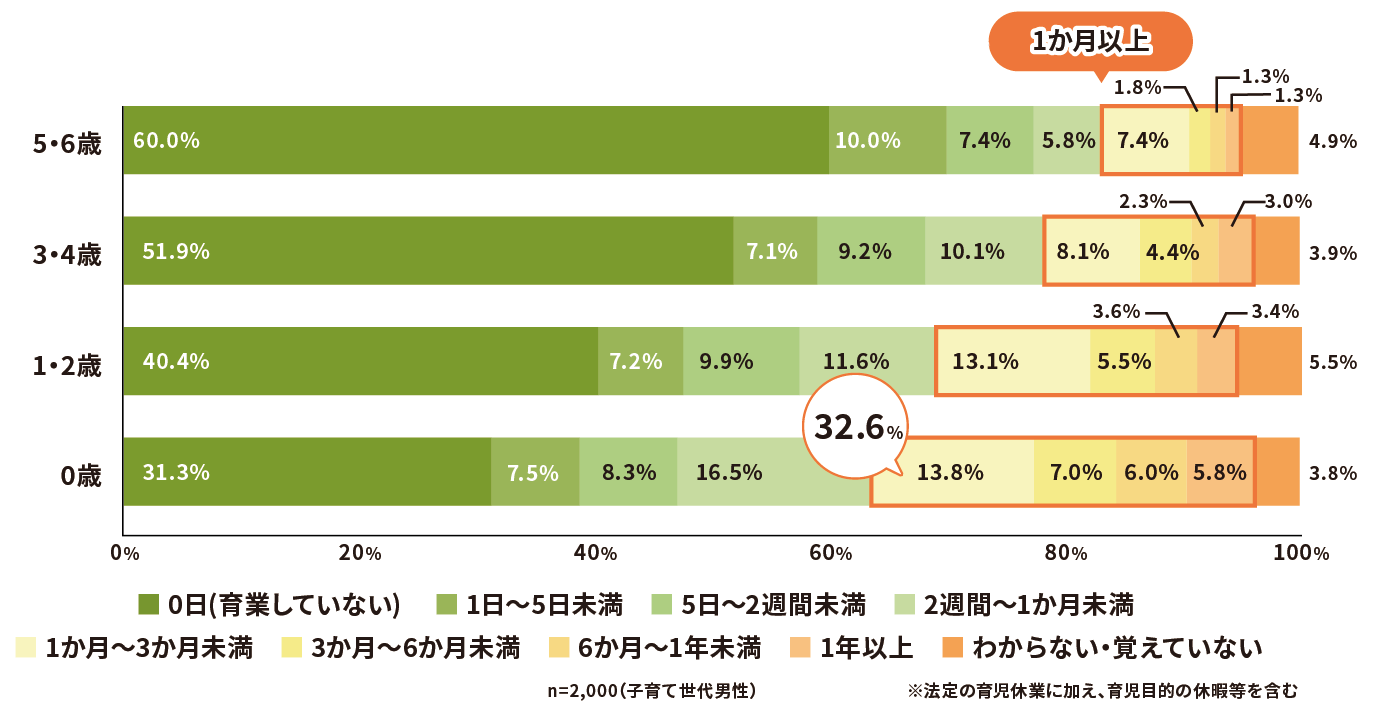
The rate of men taking childcare leave has been increasing every year. In particular, among fathers of 0-year-old children, the rate of taking childcare leave is about 65%, and of those, about 33% have taken childcare leave for more than one month, indicating that the rate and duration of childcare leave are increasing for those who have recently become fathers.
When asked why they did not take childcare leave or the duration was shorter than desired, 29% of the respondents answered “because the workplace did not have an atmosphere in which they could take childcare leave (they could not say so),” a decrease of 12.2 points from the previous survey.
As for the reason why they were able to take on childcare work as they wished or more than they wished, the top response was that “the workplace had an atmosphere that made it easy to take on childcare work or to ask for it,” and the percentage of those who thought “childcare is an important part of work” also rose 4.4 percentage points. In addition to environmental factors such as workplace atmosphere and understanding of superiors, the survey also shows that men’s own changing attitudes are encouraging them to take up childcare.
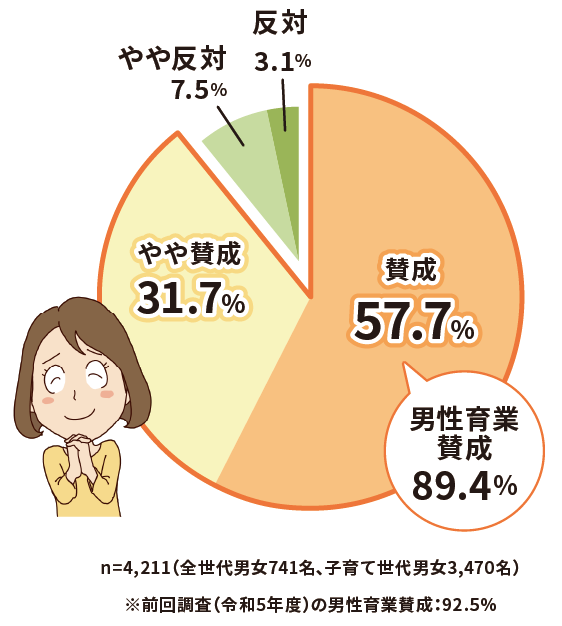
Q. How would you feel if a man in your workplace decided to take up childcare?
(2) Half of fathers of 0-year-olds “would like to do childcare again if given the opportunity.”
Q. Please indicate which of the following applies to your thinking when you finished childcare (multiple choice).
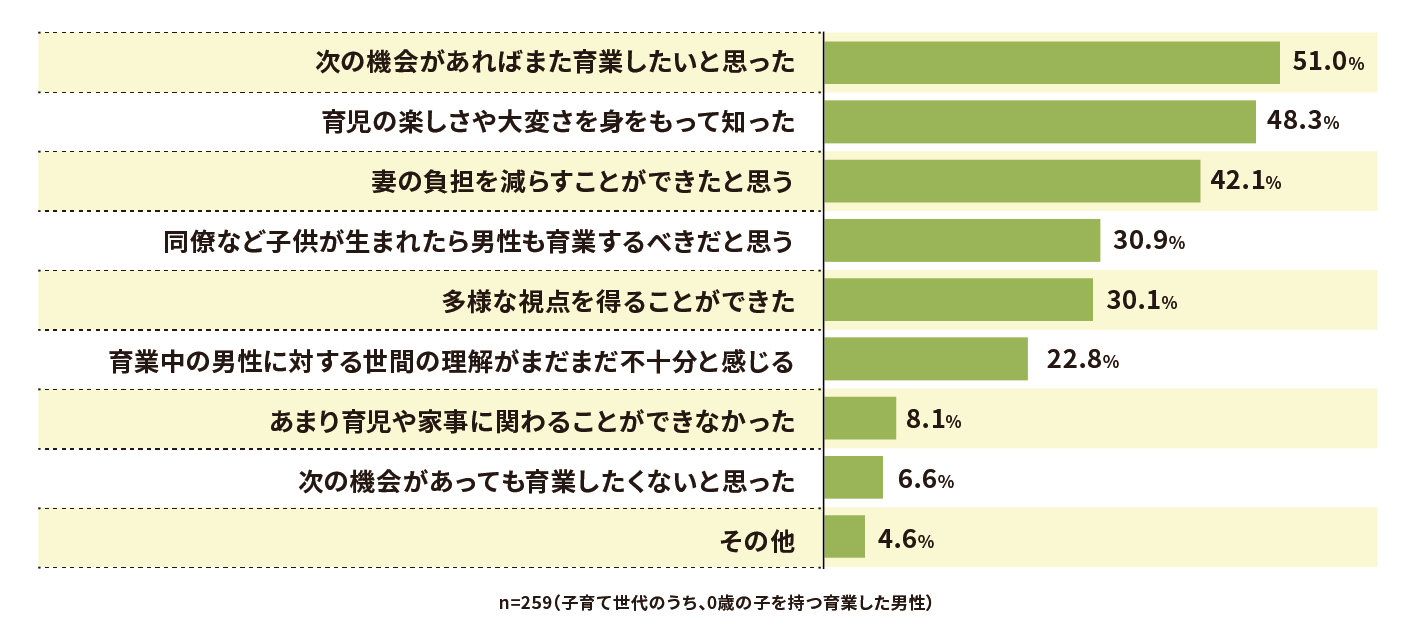
As for the thoughts of men who have completed child-rearing work, the top response was “I would like to do it again if I have another opportunity” (51.0%), followed by “I learned firsthand the joys and difficulties of child-rearing” (48.3%) and “I think I was able to reduce the burden on my wife” (42.1%). On the other hand, negative responses such as “I was not able to get involved in childcare and housework much” and “I would not want to work in childcare if I had another chance” accounted for less than 10%, indicating that most men have a positive attitude toward their childcare experience.
However, even after completing childcare, childcare continues. The real work of child-rearing begins when you return to work. Since the childcare work is only a period of time to help with child rearing, it is necessary to focus on how to balance work with housework and child rearing.
Mr. Ikeda Point
The situation regarding housework and childcare in Japan is steadily progressing, as evidenced by the rate of men taking up childcare work. However, if the number of dual-earner households increases further and more couples take on childcare for extended periods of time at the same time, the burden on the government and companies to support this will double, or double, that of the couple. The question is to what extent society as a whole will be able to support this situation.
In Sweden, it is common for married couples to take turns raising their children, with the man temporarily taking on the “one-parent-child” role. In Japan, it may be time to consider a “shift system” in which women return to work earlier and pass the baton to their husbands. I believe that a shift to a style in which each woman plays a leading role in housework and childcare is a natural trend for the future.
Mr. Amano Point
Although the percentage of men taking up childcare has increased, approval of childcare has declined slightly since the last survey. In fact, while the number of men taking up childcare is increasing, the reality is that the support system in the workplace and in the team has not been able to keep up, and it is hard to “let it go. This may indicate that we have moved from a simple view of male childcare as a good thing to a more complex phase. It can be said that companies are now at the stage of considering their next move.
On the other hand, we have received many positive comments from those who have experienced child-rearing. Child-rearing is an opportunity to become fully involved in child-rearing and has a significant impact on the subsequent parent-child relationship, the division of household chores and child-rearing, and the way of working. That is why it is important for couples to be able to run together at the starting stage. We need to be flexible so that society as a whole can continue to support them.
(3) 60% of respondents feel that men’s participation in housework and childcare is “progressing.
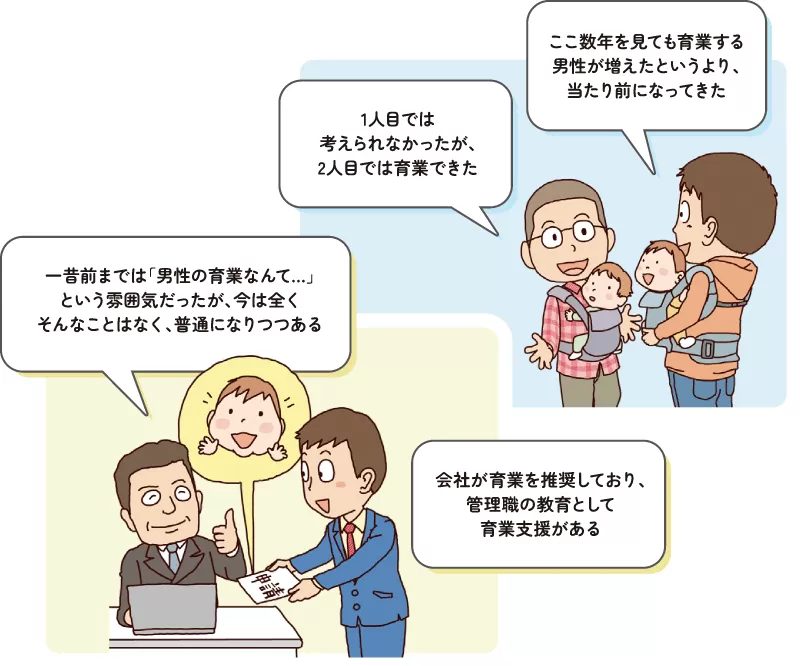
In response to the question, “Do you think men’s participation in housework and childcare is progressing?” 61% answered “strongly agree” or “agree,” indicating that about two out of three respondents recognize that men’s participation in housework and childcare is progressing. In addition, many episodes of change were reported by both men and women.
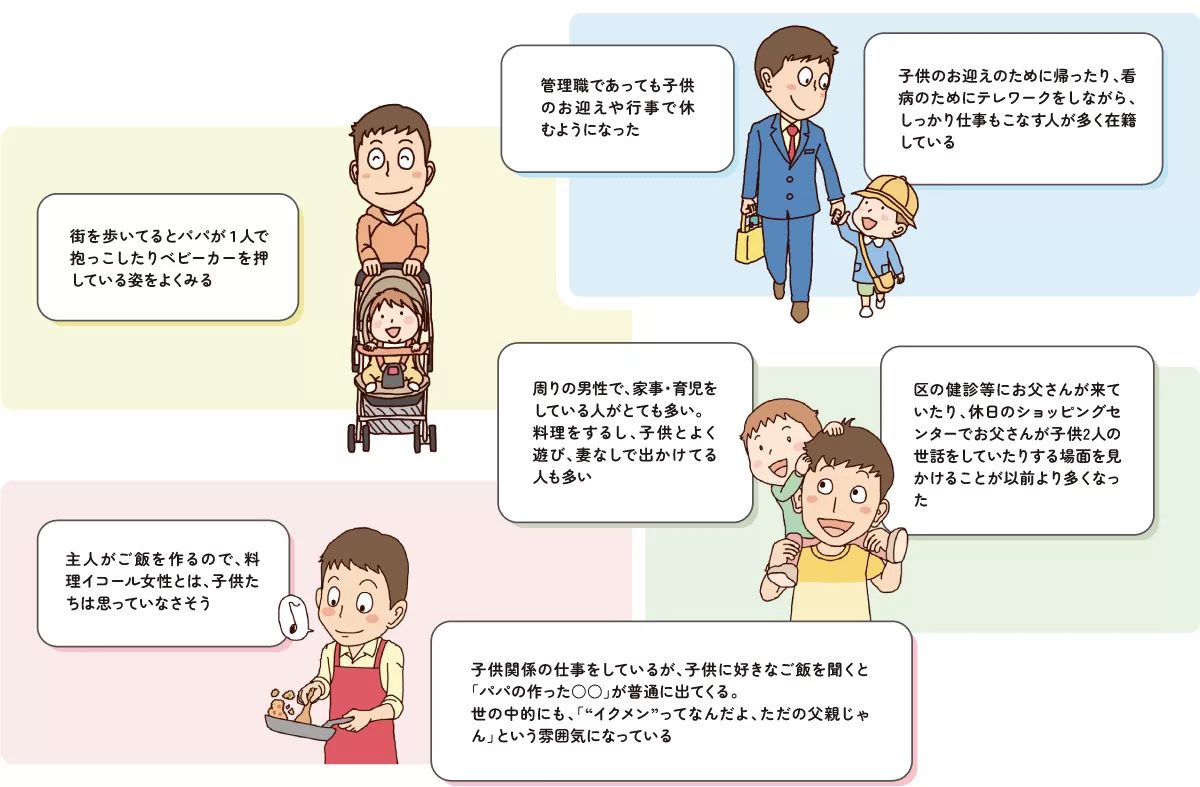
Mr. Amano Point
The increase in men’s involvement in housework and childcare may be due not only to the increase in dual-earner households, but also to their natural desire to “watch their children grow up more,” having been firmly involved in the initial child-rearing stage.
These days, men can feel a sense of belonging not only in the office but also in the local community, daycare centers, etc. “B”=Belonging in DEI&B ( * ) means “a place where you can be yourself as you are. DEI&B* is a place where you can be yourself as you are. It seems that more and more men are finding a new “place to be” after raising children.
I myself feel that “child-rearing = parent-rearing. It may seem like I am raising a child, but in fact, I am being raised the most. I believe that through parenting, we grow as a person, become aware of ourselves, and find our “place” in the world.
Diversity (D), Equity (E), Inclusion (I), Belonging (B)
Mr. Ikeda Point
Recently, men’s child-rearing styles have become more diverse, with an increasing number of “one-parent” men taking care of daycare and hospital visits in the morning and coming to work in the afternoon.
What is important is that both spouses face child-rearing with a positive attitude of not only “hard work” but also “enjoyment. It is okay to externalize difficult and troublesome housework. It is also okay to help others with childcare. By viewing time with the children as “fun” rather than “duty,” the atmosphere in the home will become brighter. I believe that is the way to raise children in this day and age.
4. both fathers and mothers are “sleep deprived” and must be careful not to overdo housework, childcare, and work!
Lack of sleep is the number one concern for both men and women! Lack of sleep is a common concern among the child-rearing generation
Q. What things in your daily life make you feel physically tired (select the top 3)?
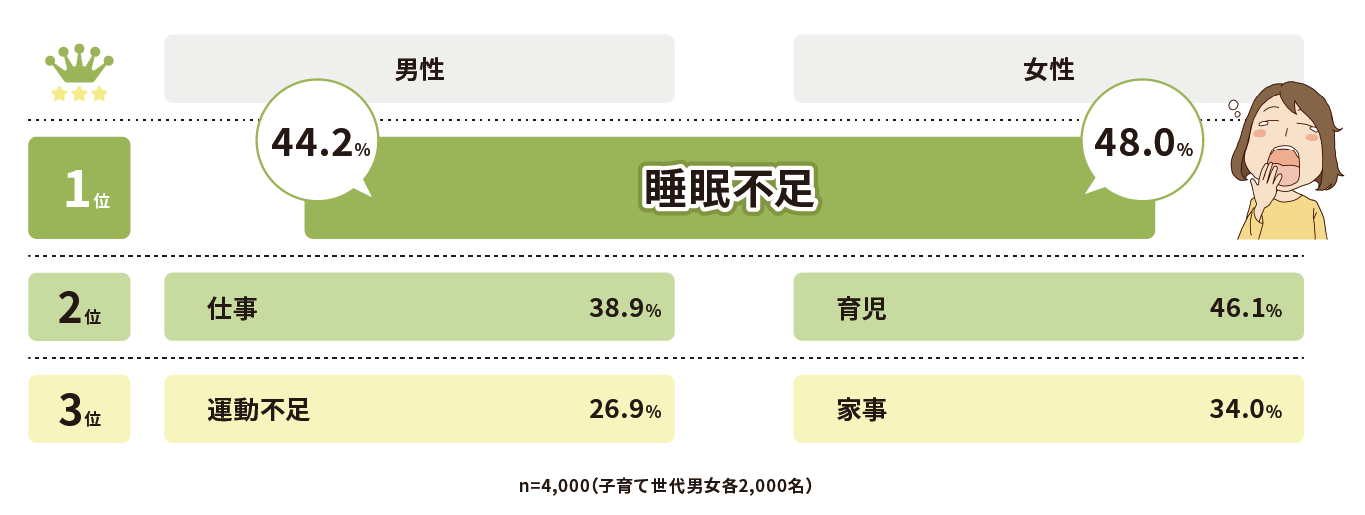
For both men and women, “lack of sleep” was the number one cause of physical fatigue. Not getting enough sleep is a serious problem for families raising children. In fact, how much sleep do moms and dads get?
(2) Real sleep situation of fathers and mothers: Not a few sleep less than 6 hours?
Q. How much sleep do you get on weekdays (average daily)?
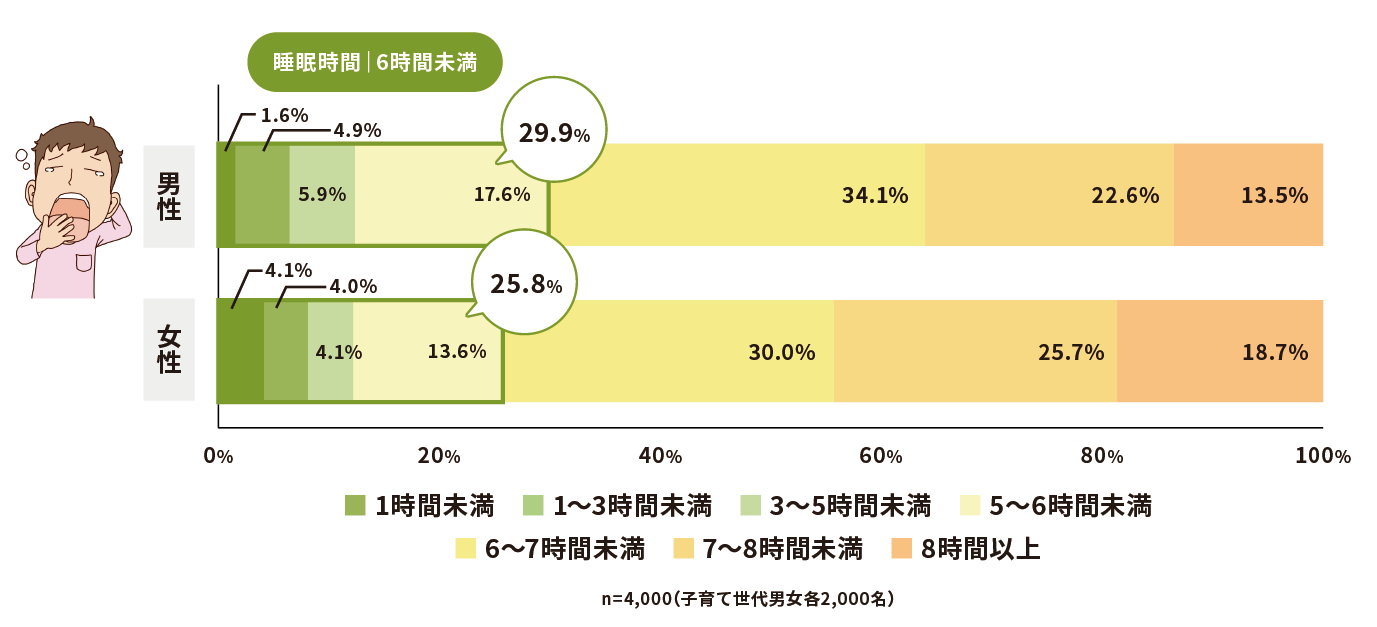
According to the “Sleep Guide for Health Promotion 2023” (Ministry of Health, Labor and Welfare), the appropriate amount of sleep is “6 to 8 hours.
Among them, 29.9% of men and 25.8% of women answered “less than 6 hours”, which is less than the appropriate amount of sleep. This means that about one in three fathers and one in four mothers are in a state of sleep deprivation.
(3) About 30% of fathers worry about “not having enough time for housework and childcare
Q. [Men] Please select the most common problems you have with yourself (multiple choice).
![Men] Please select the most important concerns you have about yourself (multiple choice).](/hp/wp-content/uploads/2026/01/P13-01-2.png)
While many respondents answered “nothing in particular,” 30% of men were concerned about “not having enough time for housework and childcare,” indicating that many men want more time for housework and childcare. Another 20% said they “want their partner to take on housework/childcare, but cannot communicate well,” again indicating communication problems between spouses.
Men are “at work” and women are “at home” Gender differences in mental fatigue
Q. What things in your daily life make you feel mentally fatigued (select the top 3)?
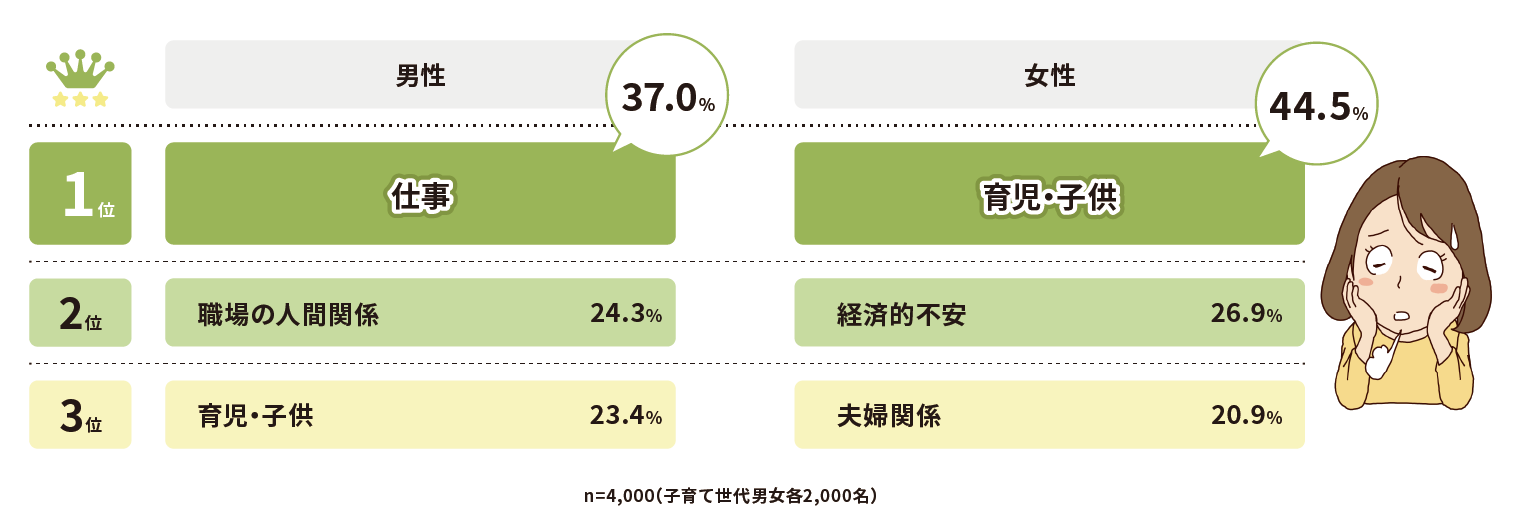
There was a significant difference between men and women in terms of the mental fatigue they experience in their daily lives. Men ranked “work” first (37.0%), followed by “interpersonal relationships at work” (24.3%), with work-related issues topping the list. On the other hand, women’s concerns were mainly related to their families, with “childcare/children” (44.5%), “financial concerns” (26.9%), and “marital relationship” (20.9%) coming in at No. 1, No. 2, and No. 3, respectively.
Some men said, ” Sometimes I am told that I am not doing any housework or childcare even though I am doing it,” and ” Sometimes I feel that there is a lack of understanding of men’s efforts in their work. Some men may want to do their best in both work and housework, but they are required to do more and more, and they may become frustrated and stressed in the days when things do not go as smoothly as they would like.
Mr. Ikeda Point
If you try to do all the housework, childcare, and work perfectly, you will inevitably run out of time. This is why the “shift work” perspective is so important. It is especially important for men to take on all housework and childcare so that women can have time free from housework and childcare.
Men, like women, also feel anxiety and pressure about housework and childcare, but many are unable to express this in words. That is why it is important to create opportunities for fathers to connect and talk with other fathers in the community. If men can expand their networks and support programs, I believe we can move closer to a more flexible and supportive parenting society.
Mr. Amano Point
There was a time when I too suffered from trying to do everything perfectly. Now, I think that a score of “30 points for housework, 30 points for childcare, and 30 points for work,” or a total of 90 points, is sufficient. It is important for couples to share “compromise points” and not set the passing score too high.
Recently, “postpartum depression” among men has been on the rise. This is due to social isolation, which is why it is important to create a community where men can feel free to talk to each other about their feelings of weakness. Just by being connected, our hearts will be much lighter. Above all, sleep is really important. Lack of sleep increases the risk of depression, so getting a good night’s sleep can help prevent depression. Even if your house is a little messy, it is an excellent choice to go to bed early, telling yourself that “dust will not kill you.
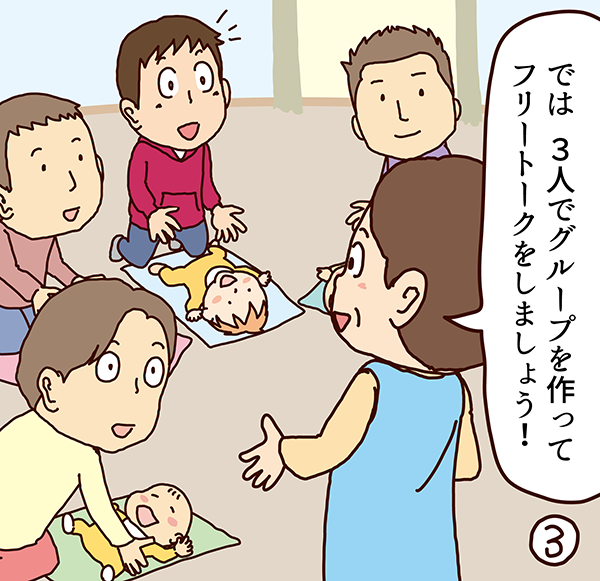
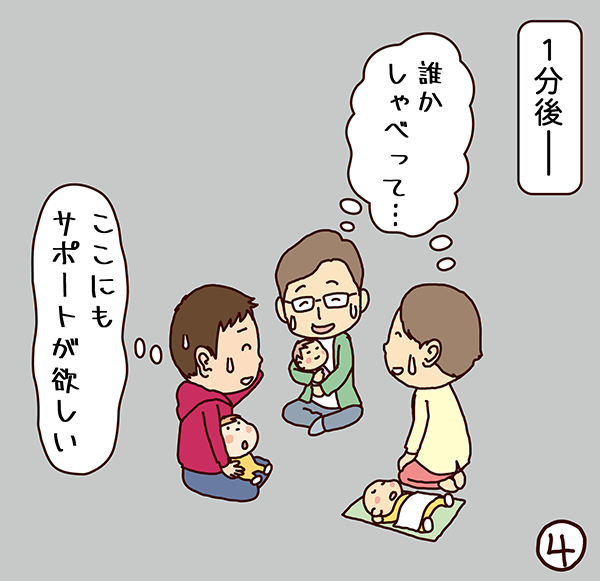
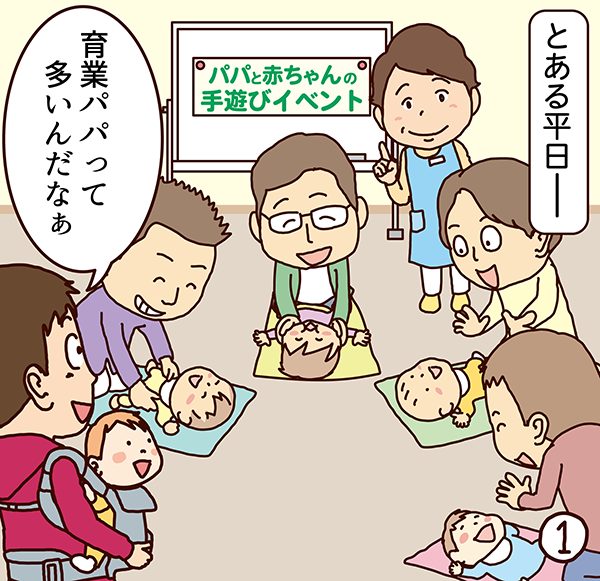

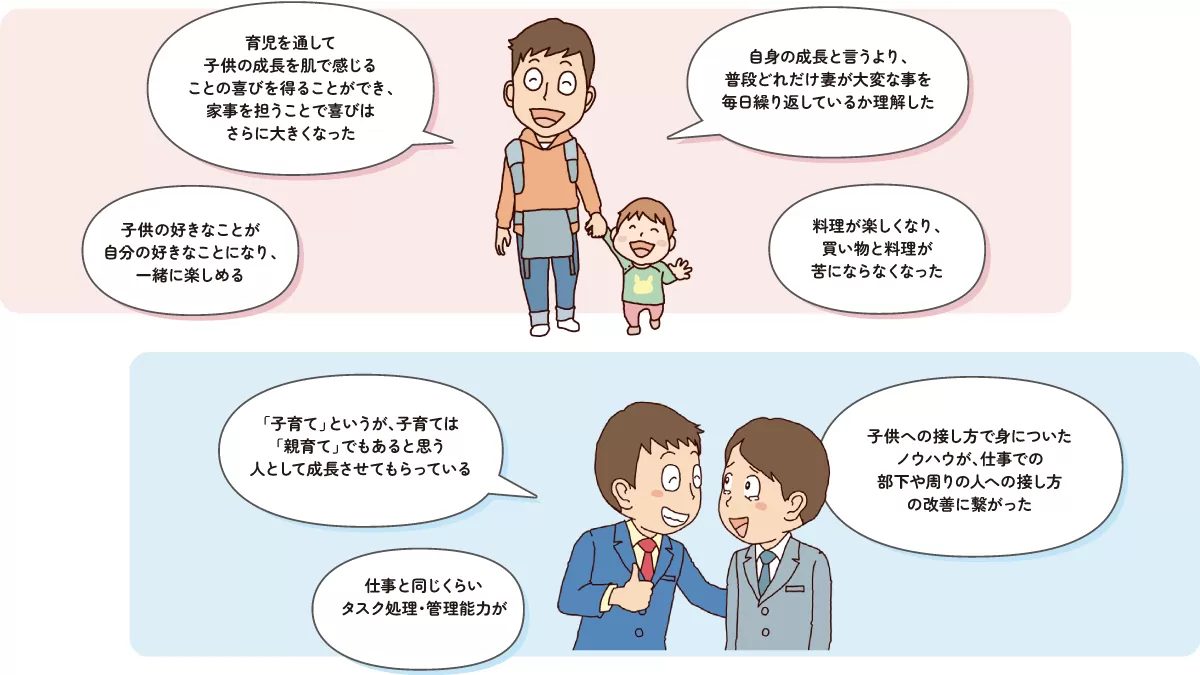
(5) Raising Children is “Raising Parents”: Fathers Discover New Myself through Housework and Childcare
In the busy days of balancing work with housework and childcare, physical and mental worries are inevitable. Nevertheless, we have received many comments from fathers about the joys and new discoveries they have made through housework and childcare!
Mr. Ikeda Point
In child rearing, there is still a strong sense of gender-based division of roles. While it is becoming more common in society for men to take on housework and childcare, I think that society should be more tolerant of women not taking on housework and childcare because of their work, and men taking on housework and childcare instead of work. From this perspective, it is most important for couples to discuss both work and housework/childcare so that “those who can do it will do it. I believe that a society that recognizes that each family has its own way to work, housework, and childcare is fine is one that will support the child-rearing generation.
Mr. Amano Point
Parenting time is a fleeting, fleeting period in a long life. Children grow up quickly, and as they get older, the opportunities for parental involvement naturally diminish. That is why I want you to think of this moment as a “premium ticket” and cherish it.
Of course, every day is hard, and there are times when we want to cry or feel depressed. But even if that is the case, the time we spend laughing with our children and watching them grow up is one of the happiest times in human life. It doesn’t have to be perfect. Let’s relax a little and enjoy this moment together.
While positive changes have been seen, such as a narrowing of the gap between men and women in terms of time spent on housework and childcare and an increase in satisfaction with the division of housework and childcare, challenges such as the balance of free time between husband and wife and lack of sleep have also become apparent. It is important for couples to find “their own style” by taking turns in childcare and discussing how they can compromise with each other. Let’s enjoy housework and childcare while maintaining good communication on a daily basis!
Introduces policies of the Tokyo Metropolitan Government that support the housework and childcare of fathers and mothers!
Provides a variety of information and advice on how to think and change housework and childcare as a “TEAM”!


To help fathers enjoy raising their children from their partner’s pregnancy to after the birth of their child, the “Dad’s Parenting Start Book” is now available as a digital book!

A counselor specializing in men’s counseling is available to address various problems men may have.

“Parenting with Your Partner Starting at Pregnancy”
We offer tips on how to make parenting with your partner meaningful from conception onward!

“Gyutto Chat”
A Tokyo Metropolitan Government chat consultation service where parents and guardians of children and child-rearing parents can talk about their daily concerns and worries free of charge and anonymously. Gyutomo,” a consultant with a variety of experiences, will listen to your concerns and worries.

We encourage companies in Tokyo to create a workplace environment conducive to childcare by offering incentives to companies whose employees take childcare leave for the desired length of time and return to their original positions.

We have introduced the results of the “Survey on Men’s Housework and Childcare 2025” twice. All survey results are available here. Please check them out!
Survey on Men’s Housework and Childcare 2025
Survey period: July 15-August 21, 2025
Survey target: 5,000 Tokyo residents (2,500 men and 2,500 women each)
Target1 Child-rearing generation … 4,000 men and women with preschool children (2,000 men and 2,000 women each)
Target2 All generations. .. 1,000 men and women aged 18-69 ( 500 men and women each)